
Choosing DMC colors for your pet's coat
How to choose DMC floss colors that match your pet: why screen colors mislead, how color matching works, and how to check threads in the shop.
By The Hoop & Paw team · Published · 2 min read
Matching thread to fur is harder than it looks: the same coat looks different in sun and shade, and screen colors are only approximate. The trick is to choose colors from the photo itself, then check the important ones in person.
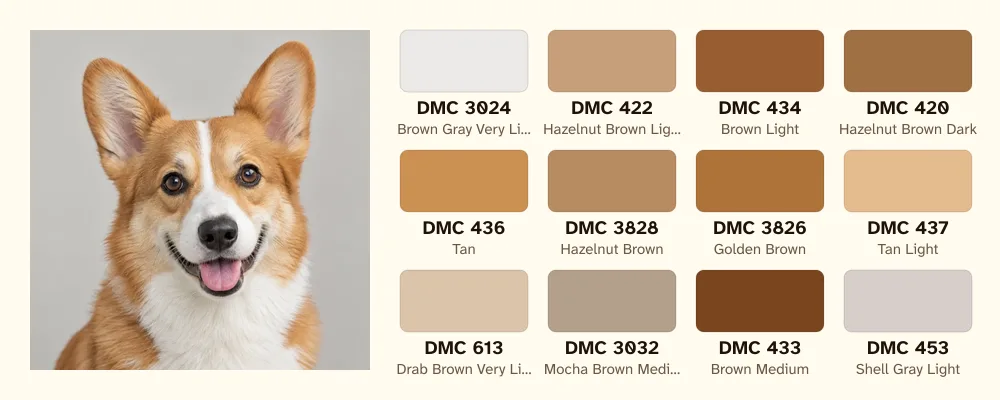
Above: a photo and the twelve DMC threads our pattern maker chose for its pattern. The palette covers the coat from its lightest highlight to its deepest shadow, plus the eyes, nose and tongue.
How matching works
Each color in the photo is compared with all of DMC's roughly 500 colors using a measure of how different two colors look to the human eye (CIEDE2000). The closest thread wins — but a good pattern also spends a few of its colors on small, important details, so a pupil or a nose isn't lost.
You can try the same matching on any color with our DMC color finder: type a hex code or click a spot on your photo.
Check the key colors in daylight
Screens and printed photos shift color. Before stitching, hold the skeins for the main coat color, the eyes and the nose against your photo — or your pet — in daylight. If one looks off, swap it for the neighbor in the DMC range and keep the rest.
Think in families, not single colors
- Warm coats (golden, red, cream) live in DMC's browns, golds and tans — 3045–3047, 433–437, 738–739, 3820s.
- Cool coats (gray, blue, silver) live in the pewter and steel grays — 413–415, 317–318, 762.
- Black and white need more shades than you'd expect: see black and white fur.
Keep the count sensible
Fifteen to twenty-five colors capture most pets well. Beyond that, extra colors are often so close to each other that they're hard to tell apart on the fabric — and each one is another skein to buy.