
Stitching black and white fur: 310, Blanc and B5200
How to cross-stitch black and white pets — tuxedo cats, border collies, Dalmatians — so the fur has shape: which blacks, whites and grays to use.
By The Hoop & Paw team · Published · 2 min read
Black-and-white pets look simple, but they're among the hardest to stitch well. With only black and white thread, the fur goes flat; the shape comes from the grays in between.
The blacks
- DMC 310 (Black) — the true black. Use it for the deepest shadows, pupils and nostrils.
- DMC 3371 (Black Brown) — softer and warmer; many black coats look more natural with it in the mix.
- Dark grays (413, 3799) — the shine on a black coat. Without them, a black cat is a silhouette.
The whites
- Blanc — DMC's standard bright white.
- B5200 (Snow White) — even brighter, slightly blue. Save it for the brightest highlights.
- 3865 (Winter White) — soft and creamy; often the best "white" for fur, especially on white fabric.
- Light grays (762, 415) — the shadows on white fur, under the chin and along the edges.
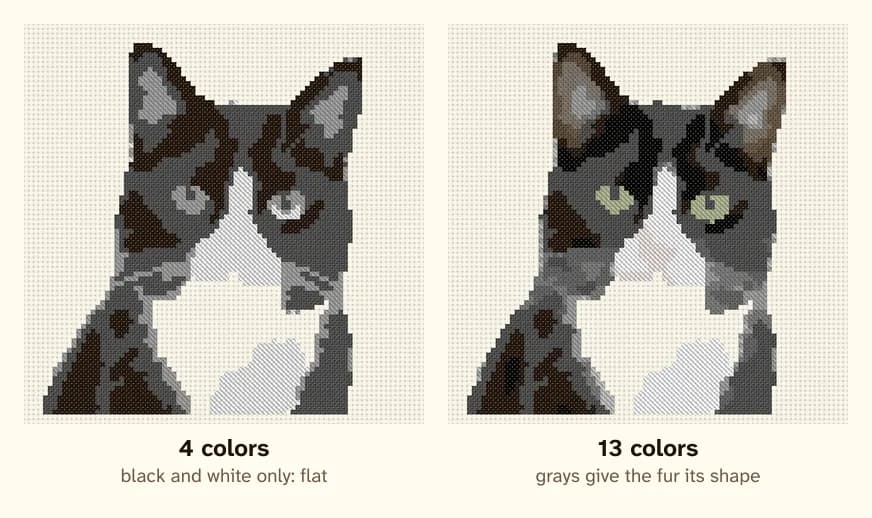
The pattern above
With four colors, the tuxedo cat is a flat black-and-white cut-out. With sixteen, the grays give the head its roundness, separate the ears from the face and show the fur on the chest. You don't need dozens — but you do need the in-betweens.
Fabric
White fur on white fabric disappears at the edges. Choose antique white, oatmeal or a soft color, or stitch a solid background behind your pet.
Eyes on a black face
Put a ring of dark gray around the eye before the black of the face, and give the eye its own color and a catchlight. Otherwise the eye merges into the fur.