
When to use backstitch in a pet portrait
Backstitch outlines can sharpen a pet portrait or make it look like a cartoon. When to use them, which color and how many strands, with a before and after.
By The Hoop & Paw team · Published · 2 min read
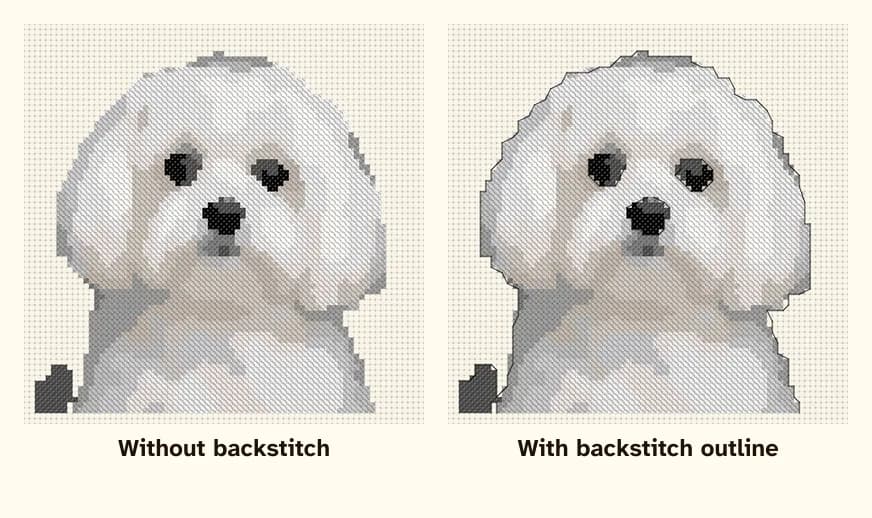
Backstitch is a line of single straight stitches worked over the top of finished crosses. In pet portraits it's used to outline — the head, the ears, the eyes — and it can change the whole look of a piece.
When backstitch helps
- Pale pets on pale fabric. A white Maltese on white Aida can lose its outline entirely; a soft gray backstitch brings the shape back (above).
- Small patterns. At 50–60 stitches, a line around the eyes and mouth adds detail the grid can't hold.
- Illustrated styles. Cute and minimal styles look best with clean outlines, like a drawing.
When to skip it
Realistic portraits of dark or mid-tone pets usually look softer and more natural without outlines — the contrast in the fur does the job.
Color and strands
- Use one strand. Two strands make a heavy line that looks like a coloring book.
- Choose a color a step darker than the fur next to it rather than black: dark brown around a golden dog, charcoal around a gray cat.
How to stitch it
Finish all the cross stitches first. Then work the backstitch from the chart, bringing the needle up one hole ahead and down into the end of the previous stitch, so the line is continuous. Keep the stitches short (one or two squares) around curves.
Our patterns include backstitch when you turn on Backstitch outlines, and list the backstitch thread separately in the key and shopping list.